UNDERSTANDING DOMESTIC VIOLENCE
The Gendered nature of domestic and family violence
Domestic violence is a ‘gendered crime’ and in the overwhelming majority of cases, women and children are the victims of men’s violence. As per UN data globally, almost one in three women have experienced physical and/or sexual violence at least once in their life. This violence is often perpetrated by current or former intimate partner.
From Shakti’s experience of working with ethnic Asian, African and Middle Eastern communities, the gendered nature of domestic violence is further evidenced in socio-cultural practices that harm women and girl children, namely female foeticide, female infanticide, dowry abuse, forced and or underage marriage, female genital mutilation and family-honour based forms of abuse and violence including so-called `honour-killing’.
According to New Zealand Ministry of Justice and Non-Government Agency sources:
- Men are much more likely than their female partner to be using a number of repeated, patterned forms of violence to dominate and control over time. Their violence is more likely to inflict severe injury and to result from attempts to control, coerce, intimidate and dominate female partners.
- Where violence may be used by both partners in a relationship, the woman’s acts are more likely to be in self-defence. At a societal level, violence is contextualised by gender relations in which men are socialised to assume male power, privilege and entitlement, particularly in family relationships with women and children. In contemporary New Zealand society, women face social, structural and economic barriers to being safe from domestic violence and achieving justice when violence occurs.
- Cultural norms and expressions of masculinity also support domination, power and control over women, and male entitlement. In this, homophobia and fear of the feminine go hand in hand. Men’s fears of being rejected from social forms and networks of male solidarity help to fuel their adherence to dominant forms of masculinity or ‘hegemonic masculinity’.
Complementary theories and perspectives on power and control – such as those that address racism, colonised experience, homophobia, or disability discrimination – also feature in Shakti programmes in addressing domestic violence.
Common misconceptions about domestic violence
Below are some common misconceptions about people who are violent towards their partners, about people who experience domestic violence and about patterns of domestic violence in different cultures and contexts:
- It’s because they drink:
There is significant evidence for a correlation between use of violence and substance abuse. However, not all people who abuse alcohol are violent, and many people are violent whether they are drunk or sober. While alcohol might disinhibit violence in some, their underlying attitudes and values are the starting point for that violence.
- They had a difficult and/or violent upbringing:
Often people seek to excuse domestic violence by suggesting that perpetrators of violence had traumatic childhoods, or that they repeat the violence they witnessed or experienced in their own family backgrounds. However not all such persons impacted by abuse are violent or abusive.
- Intergenerational Violence:
While intergenerational violence does contribute to values, beliefs and attitudes, it does not excuse domestic violence and does not account for the very large number of men and women who have been exposed to family violence and are not violent in adulthood. Nor does it explain how a significant number of people who report happy and non-violent childhoods perpetrate violence in an adult relationship.
- They have a stressful job:
Many men and women work and live in stressful environments without resorting to violence. People who are violent towards their family members usually do not also perpetrate violence towards their co-workers, employers or friends. This shows that they are able to control their responses in other environments.
- They can’t control their anger; the pressure just builds up:
Many people who perpetrate violence do so when they are not feeling angry or stressed. Many people who are angry or stressed do not perpetrate violence. Domestic violence is always unacceptable, regardless of the perpetrator’s feelings before, during or after they have been violent or controlling.
- People who perpetrate violence are mentally ill:
There is no evidence that people who are violent, as a whole, have higher rates of psychiatric disorders than other people. Given that domestic violence affects a significant proportion of the population, it cannot be explained solely in terms of ‘abnormal’ personality characteristics. Perpetrators of violence often look and act like ‘ordinary’ people.
- It’s a relationship issue:
Domestic violence is often understood or presented as a relationship issue or a dynamic between two people. For example, ‘we had a fight’ or ’it was a violent relationship’. This has the effect of ascribing some measure of blame to those who experience violence.
- Victims of domestic violence are predisposed to it:
Some people believe that some victims allow themselves to be abused, or have psychological problems that lead them to choose perpetrators of violence as their partners. However, there is no evidence that it is a particular ‘type’ of person who is likely to experience domestic violence.
Generally, these misconceptions have the effect of silencing and marginalising people who experience domestic violence.
Furthermore, they:
- Reinforce male power and privilege
- Fail to name the violence as a crime, treating it instead as a problem.
- Provide respondents/defendants with an invitation to excuse themselves and to look for causes, triggers, precipitating events and circumstances.
- Individualise the ‘problem’ by ignoring the social, cultural and historical contexts in which violence towards women and children has been excused.
- Fail to focus on perpetrators of violence stopping their violence.
- Tend to involve the victim in responsibility for the violence, often requiring them to change in order to avoid violence.
The effects of domestic violence on VICTIMS
Domestic violence has short and long-term physical, emotional, psychological, financial and other effects on victims. Every victim is different and the individual and cumulative impact of each act of violence depends on many complex factors. While each person will experience domestic violence uniquely, there are many common effects of living with violence and living in fear.
Children and young people do not have to be physically present during domestic violence events to be negatively affected by it. Exposure to violence can take the form of witnessing the abuse, hearing the abuse, being aware of the abuse, being used or blamed as a trigger for domestic violence, or seeing the consequences of domestic violence.
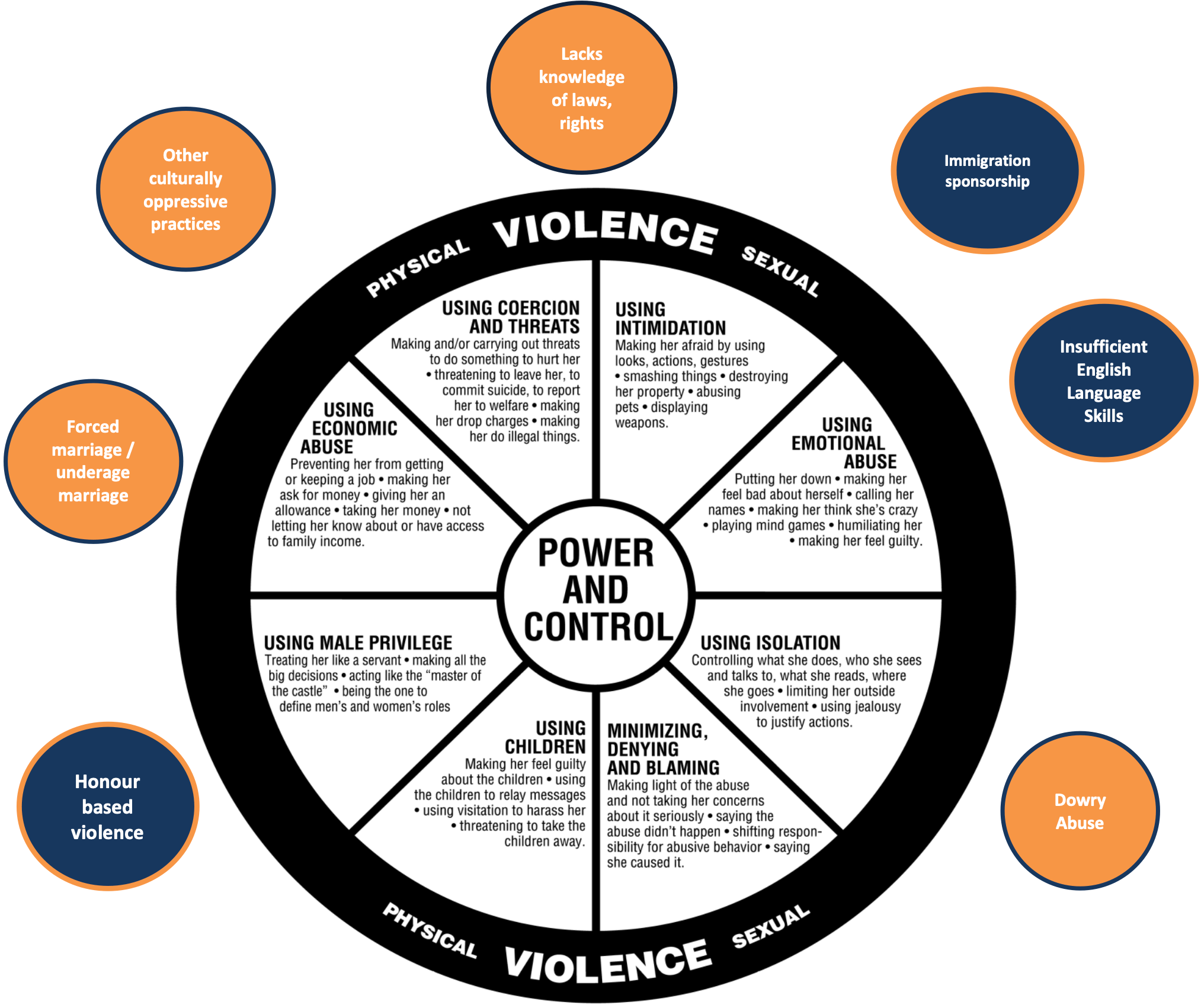
POWER & CONTROL WHEEL
IMMIGRANT WOMEN POWER & CONTROL WHEEL
Adapted from the Duluth Model
www.theduluthmodel.org